An AI agent is not a chatbot with a new name. A chatbot answers. An agent works.
The difference between them is a loop.
The loop, in plain terms
A chatbot takes your question and returns an answer. One turn, finished.
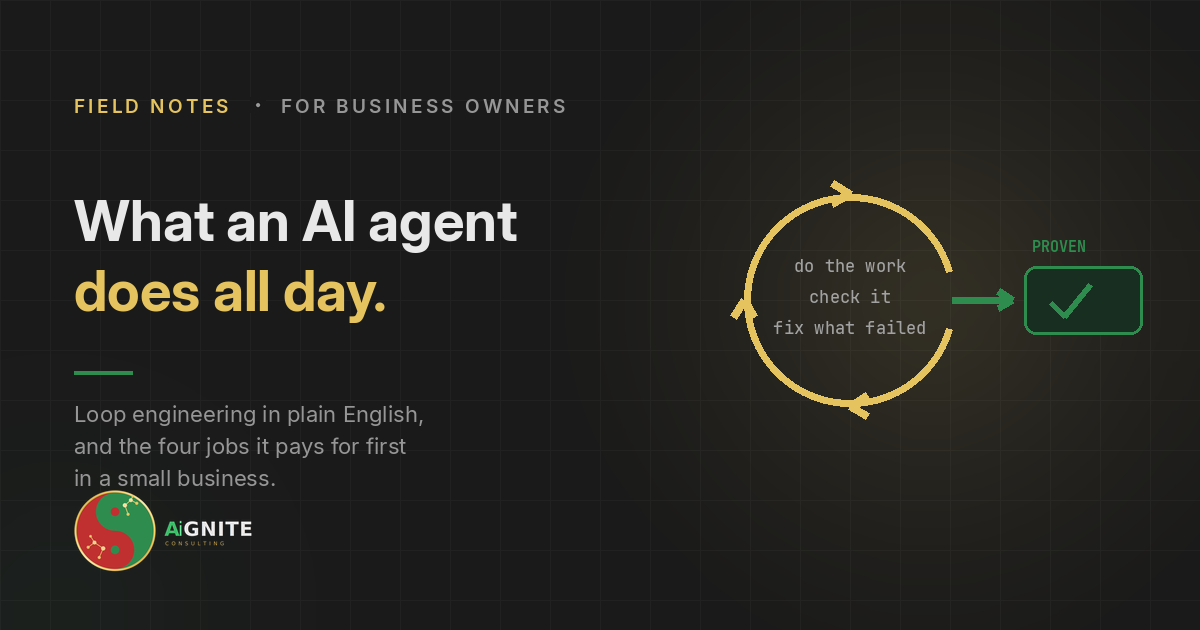
An agent runs a cycle. It takes an action, looks at the result, decides what to do next, and goes again. It repeats until the job is done or something stops it.
Take a task from a real office. A customer emails asking where their order is.
A chatbot writes a polite reply and guesses at the details.
An agent does this instead. Reads the email and works out what the customer wants. Looks up the order in your system. Checks the shipping status with the carrier. Compares the result against your refund policy. Drafts the reply with the real tracking number in it. Sends it, or hands it to a person when the answer falls outside your rules.
Five steps, each one feeding the next. That cycle is the loop. Designing it well is what people mean by loop engineering.
Why the loop needs a stop
Two things go wrong without a designed stopping point.
The agent spins. It keeps checking, keeps re-reasoning, keeps calling the same tool on a task it will never finish. Every pass costs money.
Or the agent decides the job is done and is wrong. This one is quieter and more expensive.
I lost five days on a project where the database reported a successful setup. Ten tables had failed to create. The screens looked correct, because the software filled them with substitute data. Nothing raised an alarm. The system said finished, and finished was false.
The check has to come from outside
Here is the one rule worth taking from this article, whatever software you buy.
The thing deciding the work is done must not be the thing doing the work.
You would not accept a contractor signing his own final inspection. Same principle. In a well-built AI system, a separate check runs after the agent stops. Real system, real data, real numbers. If the check fails, the agent goes back to work. The agent gets no vote.
Most AI demos skip this entirely. The demo shows the agent producing something. Nobody shows what happens on the day the agent produces something wrong and reports that it went fine.
The four jobs agents pay for first
Start where the work repeats, the rules are clear, and a wrong answer is visible.
Quotes and proposals. The agent pulls your pricing, reads the request, and produces a first draft. You set the number and send it. An afternoon becomes ten minutes.
Invoices and receipts. The agent reads the document, pulls out amounts and dates, and files them. The check here is arithmetic, so the software verifies its own work precisely.
Customer email. The agent drafts replies grounded in your own documents and prices, not in general knowledge. A person approves anything involving money or a promise.
Weekly reporting. The agent reads your spreadsheets and systems on a schedule and produces the same summary every Monday, in the same shape, without being asked.
The pattern in all four: repeated input, a clear rule for right and wrong, and a person on every decision with consequences.
Five questions to ask before you buy
Ask any vendor these. The answers separate working software from a demo.
- What does your system check after it finishes, and who wrote that check?
- Show me what happens when a step fails. Not the happy path.
- Does the check run against my real system with my real data, or against a test copy?
- Where does a person stay in the process, and why there?
- What does the system do when it is unsure? Guess, stop, or ask?
Question five matters most. Software confidently producing a wrong answer costs more than software stopping to ask.
What agents do not do
They do not replace judgment on anything with consequences. Pricing a deal, dropping a supplier, promising a customer a refund outside policy. Those stay with you, and a well-built system keeps them there on purpose.
They do not work on tasks with no clear definition of right. If you struggle to say what a good output looks like, the software has no way to check itself, and you are buying a guess.
They do not remove the setup work. Connecting an agent to your real systems and building the check takes longer than building the agent. Budget most of the time there. Anyone quoting you an afternoon has skipped the check, and the check is the part keeping you out of trouble.
Where to start
Pick one task you do every week that follows the same steps every time.
Write down what a correct result looks like, in one sentence a stranger would understand.
That sentence is the whole project. Everything after it is wiring.