Hyperlocal Air Quality &
Compliance Intelligence
for Houston's Industrial Corridor
See AirShield Live
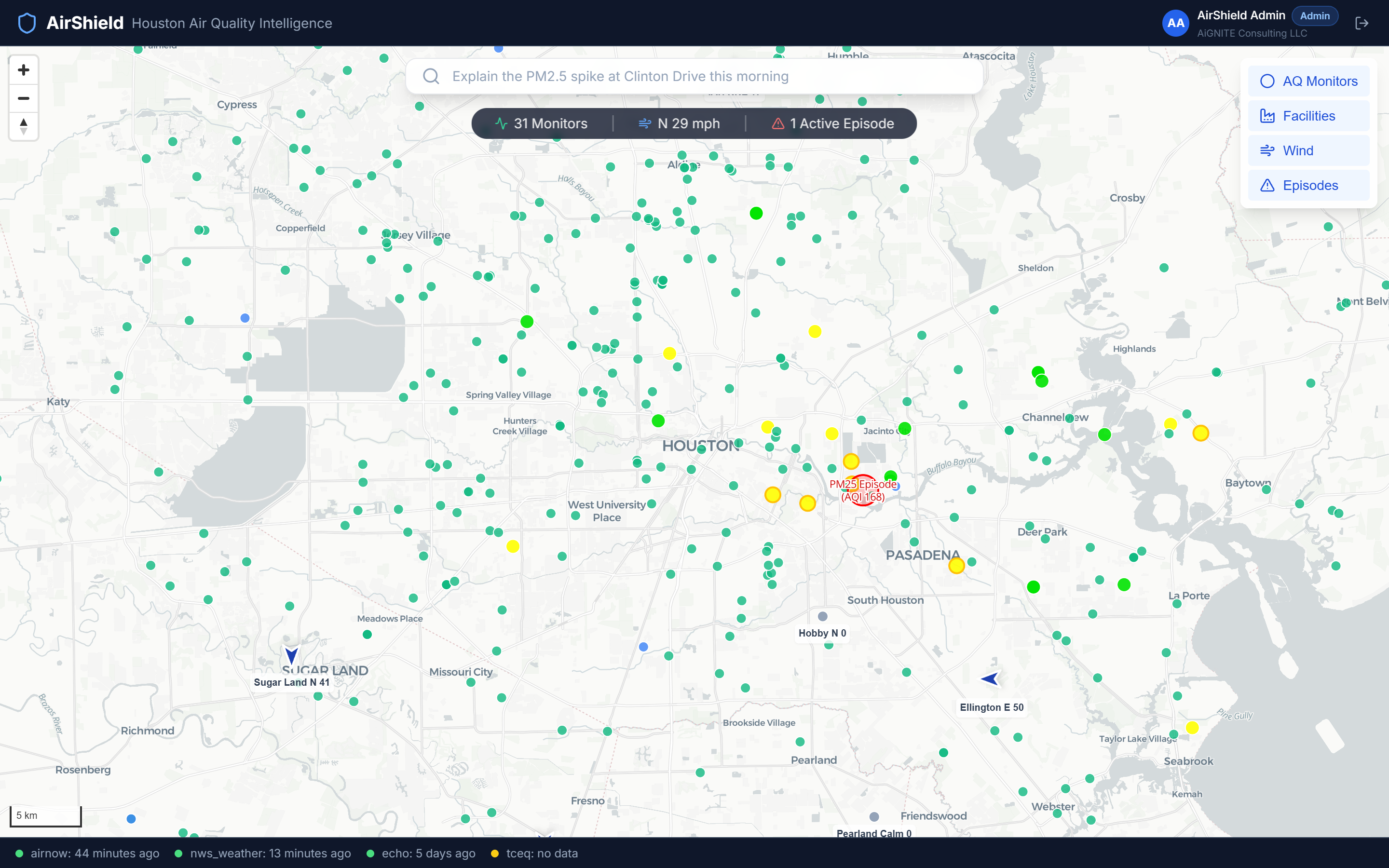
Explore the live platform, real-time AQ readings, 21,000+ ECHO facilities, 12 NWS wind stations across Greater Houston
Eight Tools. One Platform.
Everything an environmental compliance team needs to turn air quality data into auditable intelligence.
Real-Time Air Quality Map
Interactive map with every EPA AirNow and TCEQ monitor across Greater Houston, color-coded by official EPA AQI breakpoints. Click any monitor for current reading, 24-hour sparkline, baseline comparison, and nearest wind station data. Pulsing markers for USG and above alert you to developing events at a glance.
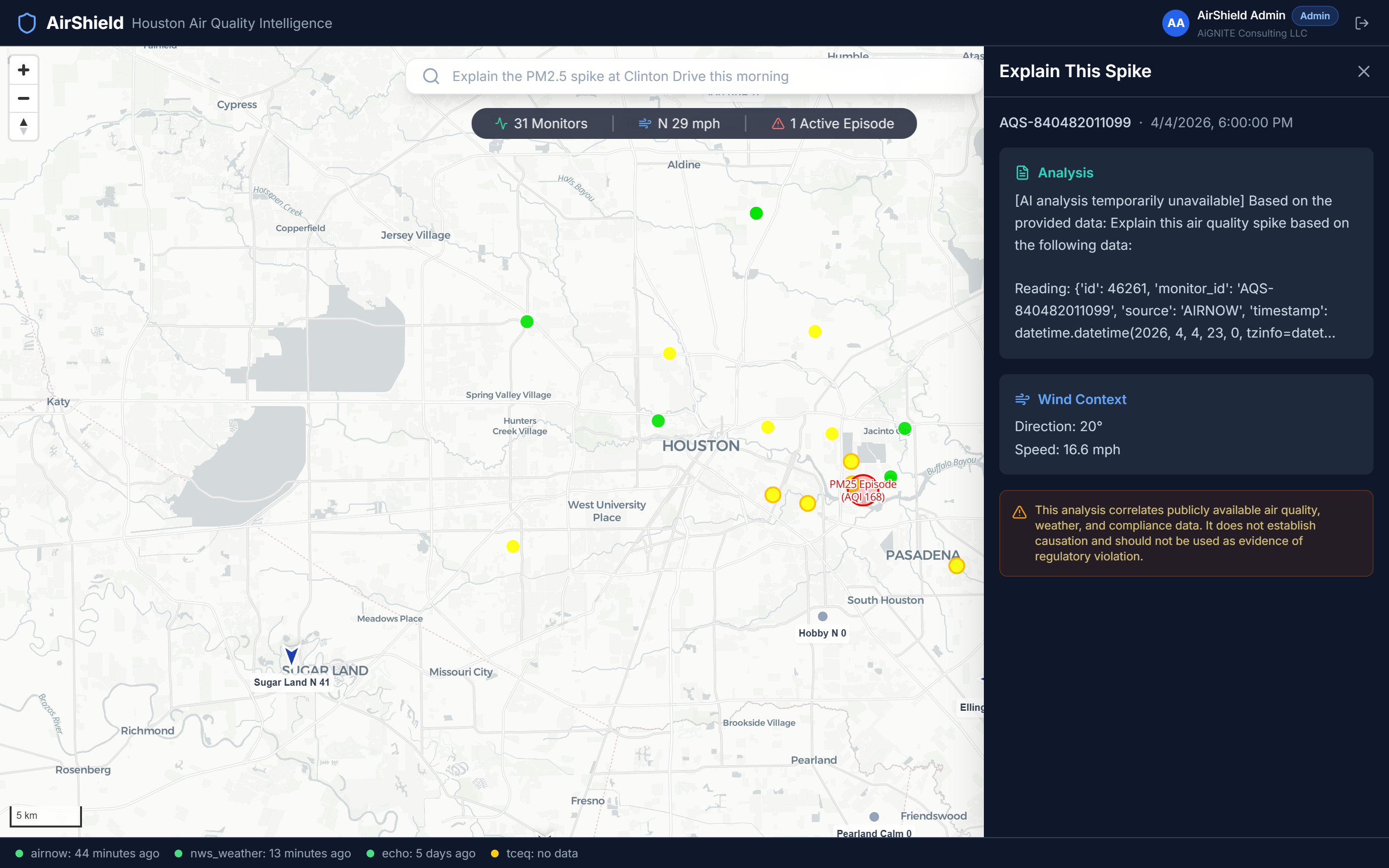
Explain This Spike
AirShield's killer feature. When an air quality anomaly is detected, the system generates a fully cited narrative: what was observed, wind direction and speed at the time, which ECHO-regulated facilities were upwind, their compliance history, and similar past episodes. Every claim cites a specific EPA, NWS, or ECHO record. Correlation language only, never causation.
Wind-Conditioned Analysis
12 NWS weather stations across Greater Houston feed real-time wind overlays onto the map. Directional fingerprints per monitor show average AQ readings bucketed by 16-point compass direction, revealing which wind bearings correlate with elevated readings. Upwind facility identification uses PostGIS spatial analysis with configurable cone width and radius.
Facility Compliance Scorecards
21,000+ EPA ECHO-regulated facilities mapped across Harris and six surrounding counties, each with a computed compliance score (0–100) and letter grade (A–F). Scores weight violation count, penalty severity, inspection recency, current ECHO status, and proximity to sensitive receptors. All data sourced from public EPA ECHO records.
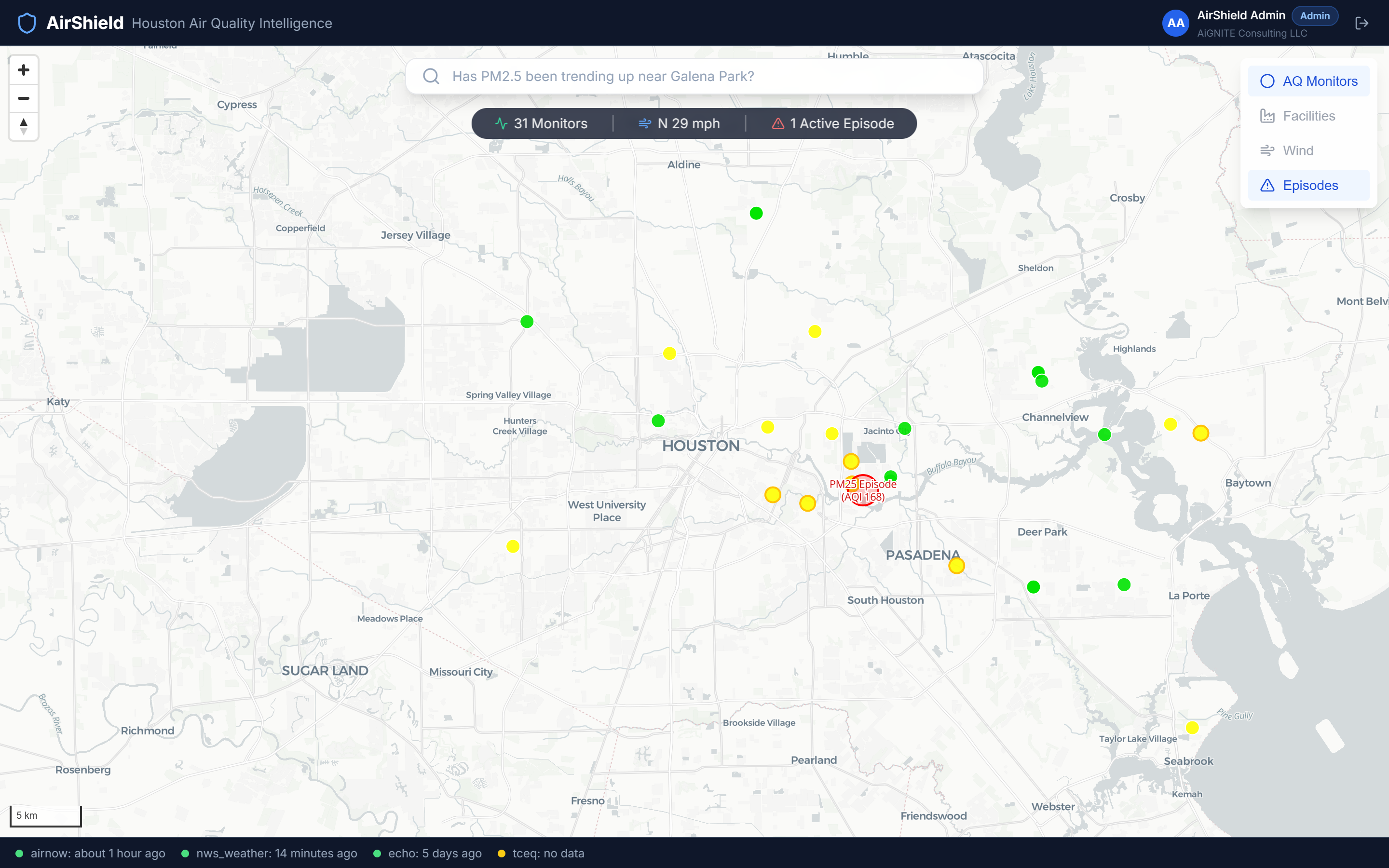
Episode Detection & Clustering
Automatically clusters temporally-adjacent air quality anomalies across multiple monitors into episodes. Two or more monitors within 15 miles showing anomalies for the same parameter within 2 hours triggers episode creation. Each episode includes meteorological context and nearby facility compliance records.
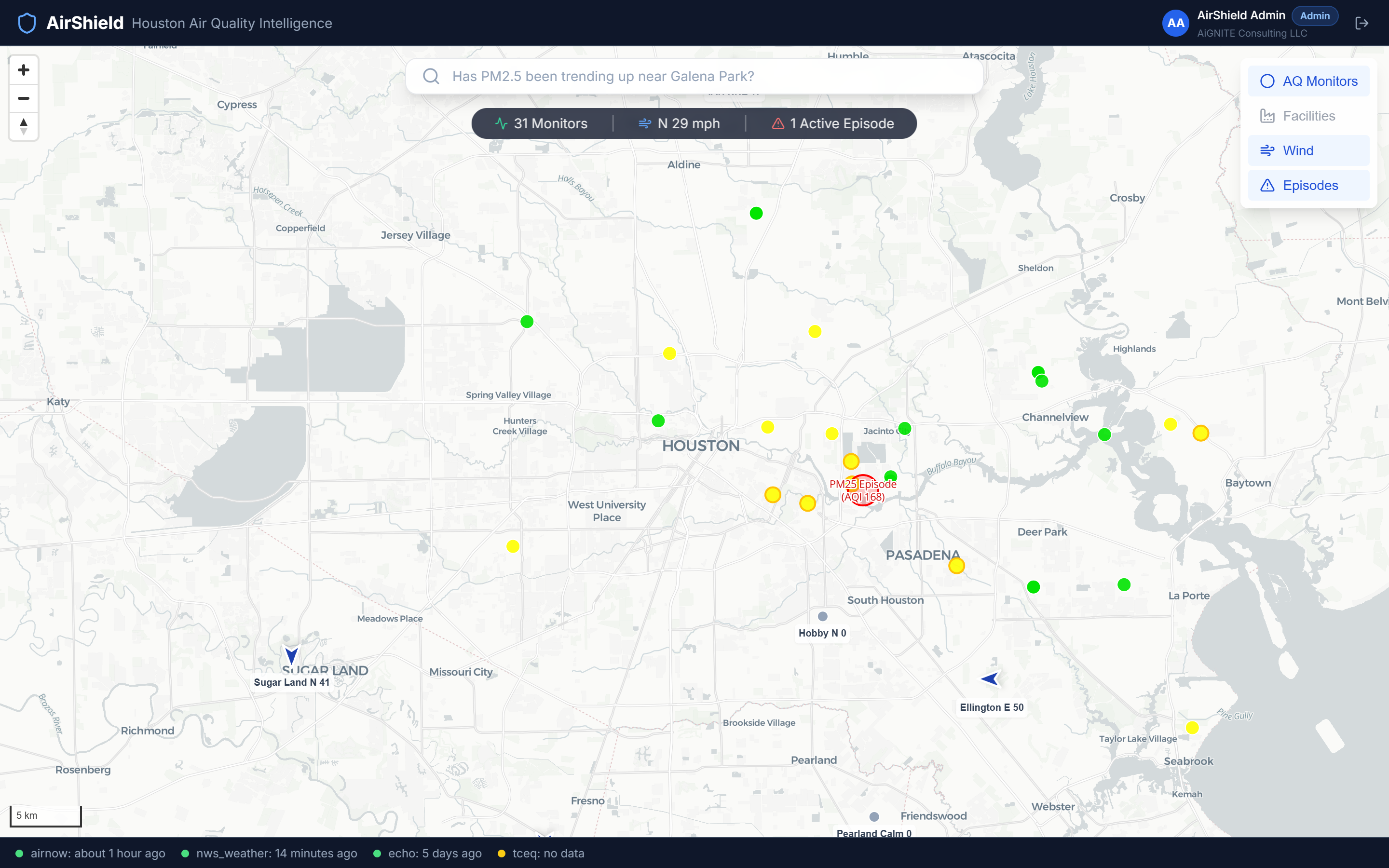
Natural Language Query
Ask air quality questions in plain English. ‘Has PM2.5 been trending up near Galena Park this quarter?’ or ‘Show me facilities with ECHO violations within 3 miles of Milby Park.’ AirShield decomposes your question into database queries, retrieves real data, and generates a cited narrative, never hallucinated citations.
D3 Wind Rose Visualization
Interactive polar chart showing the directional AQ fingerprint for any selected monitor. Each of 16 compass sectors displays average pollutant concentration when wind blows from that direction. Elevated sectors are highlighted, and upwind ECHO facilities in those bearings are listed. Built with D3.js for smooth, interactive exploration.
MCP Integration
Connect Claude Desktop, Cursor, or any MCP-compatible AI tool to AirShield. Get air quality summaries, explain anomalies, query facility compliance, search episodes, analyze wind patterns, and run trend analysis, all from within your existing AI workflow. Six MCP tools available, all returning structured citations.
From Raw Data to Cited Intelligence, Automatically
Ingest
Four government data sources polled continuously: EPA AirNow (hourly), NWS wind (every 15 min), EPA ECHO (weekly), TCEQ (daily). All readings normalized with PostGIS spatial indexing.
Detect
Anomaly detection flags readings >2σ above 30-day rolling baselines (bucketed by hour-of-day for diurnal patterns) and EPA AQI threshold crossings.
Correlate
Wind data joined to AQ readings via temporal proximity (<30 min window). Upwind ECHO facilities identified using ST_Azimuth with 45° cone width and 10-mile radius.
Cluster
Multi-monitor anomalies clustered into episodes. Each episode tagged with meteorological context, upwind facilities, and compliance records.
Explain
PLAN/EXECUTE/ANALYZE/SYNTHESIZE intelligence engine generates cited narratives from real database records. Every claim traceable to a specific data point.
The Platform
Real-Time Air Quality Map
Explain This Spike
Facility Compliance Scorecard
Wind Rose Analysis
4 Government Data Sources. Real-Time. Zero Proprietary Data.
| Source | Frequency |
|---|---|
| EPA AirNow | Every 60 minutes |
| EPA ECHO | Weekly refresh |
| NWS Weather API | Every 15 minutes |
| TCEQ TAMIS | Daily |
All data sourced from public U.S. government databases. No commercial data licensing required. Every AI-generated claim includes verifiable citations to the specific monitor reading, NWS observation, or ECHO record that supports it. AirShield correlates publicly available data. It does not establish causation.
Built for Houston's Ship Channel Corridor
ESG & Compliance Managers
Replace manual AirNow checks and spreadsheet downloads with a real-time intelligence dashboard. When your board asks about air quality near your Baytown facility, show them an auditable, cited analysis — not a raw data dump. Compliance scorecards use public EPA ECHO data to give your team a clear picture of your regulatory posture.
Community Affairs & Environmental Justice
School districts, health departments, and community groups near the Ship Channel need air quality intelligence they can trust. AirShield maps every monitor and facility, explains anomalies with cited evidence, and identifies sensitive receptors — schools, hospitals, parks — within proximity of regulated facilities.
Environmental Consultancies
Monitor air quality across your entire Houston client portfolio from a single map. Wind-conditioned analysis shows which bearings correlate with elevated readings at each monitor location. Episode reports with full citations are audit-ready and exportable as PDF for ESG documentation.
Environmental Attorneys & Insurance
Research EPA ECHO compliance records, AQ monitoring data, and meteorological context in seconds. Full citation provenance trails for litigation support. Wind-conditioned facility correlation analysis provides a factual evidence base — every claim grounded in public government data.
Interested in AirShield?
Contact us to discuss your use case and request a personalized demo.
Contact UsPLAN / EXECUTE / ANALYZE / SYNTHESIZE
Every AI-generated response follows a four-phase pipeline proven across three AiGNITE platforms, ensuring every claim is grounded in real database records with traceable citations.
PLAN
AI decomposes your question into 1–5 specific database queries targeting the exact monitors, facilities, wind stations, and time ranges needed to answer.
EXECUTE
Each query runs against real PostgreSQL + PostGIS + TimescaleDB tables. Returns actual rows with real monitor IDs, real ECHO registry IDs, real timestamps — never fabricated data.
ANALYZE
AI reasons over the combined real data to identify patterns: which monitors spiked, what the wind was doing, which facilities were upwind, whether similar episodes occurred before.
SYNTHESIZE
AI generates a cited narrative using ONLY the retrieved data. Every factual claim includes a citation: [Source: ID, timestamp]. No hallucinated citations. No uncited claims.
This pattern was proven in Beacon GoM, RegScope, and AirShield. It transforms raw data into auditable intelligence.
Ready to See Your Facilities on the Map?
Request a 15-minute live demo using your own facility's ECHO compliance data and nearby AQ readings in real-time. No pitch deck, just the product.