Know Your Flood Risk
Before the Water Rises
See FloodPulse in Action
Demo video coming soon
3-minute product walkthrough, from live gage monitoring to cited risk intelligence
Eight Tools. One Platform.
Everything a flood-exposed organization needs to turn raw gage data into cited intelligence with full source traceability.
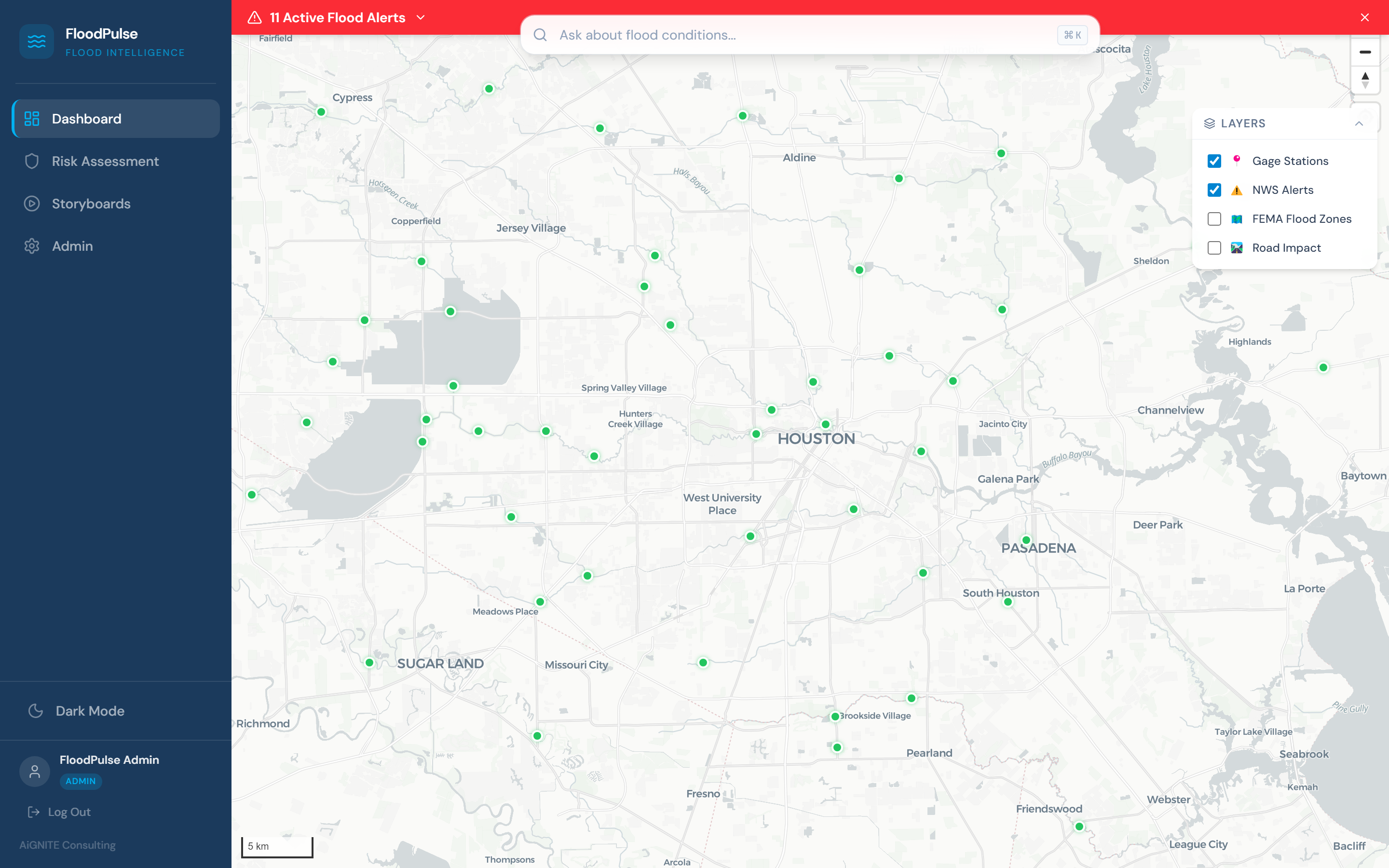
Real-Time Flood Map
63+ live gage stations from HCFCD, color-coded by status (normal, elevated, minor flooding, major flooding). Interactive map with watershed boundaries, bayou overlays, and FEMA flood zone polygons. Click any gage for live readings and 24-hour trend sparklines.
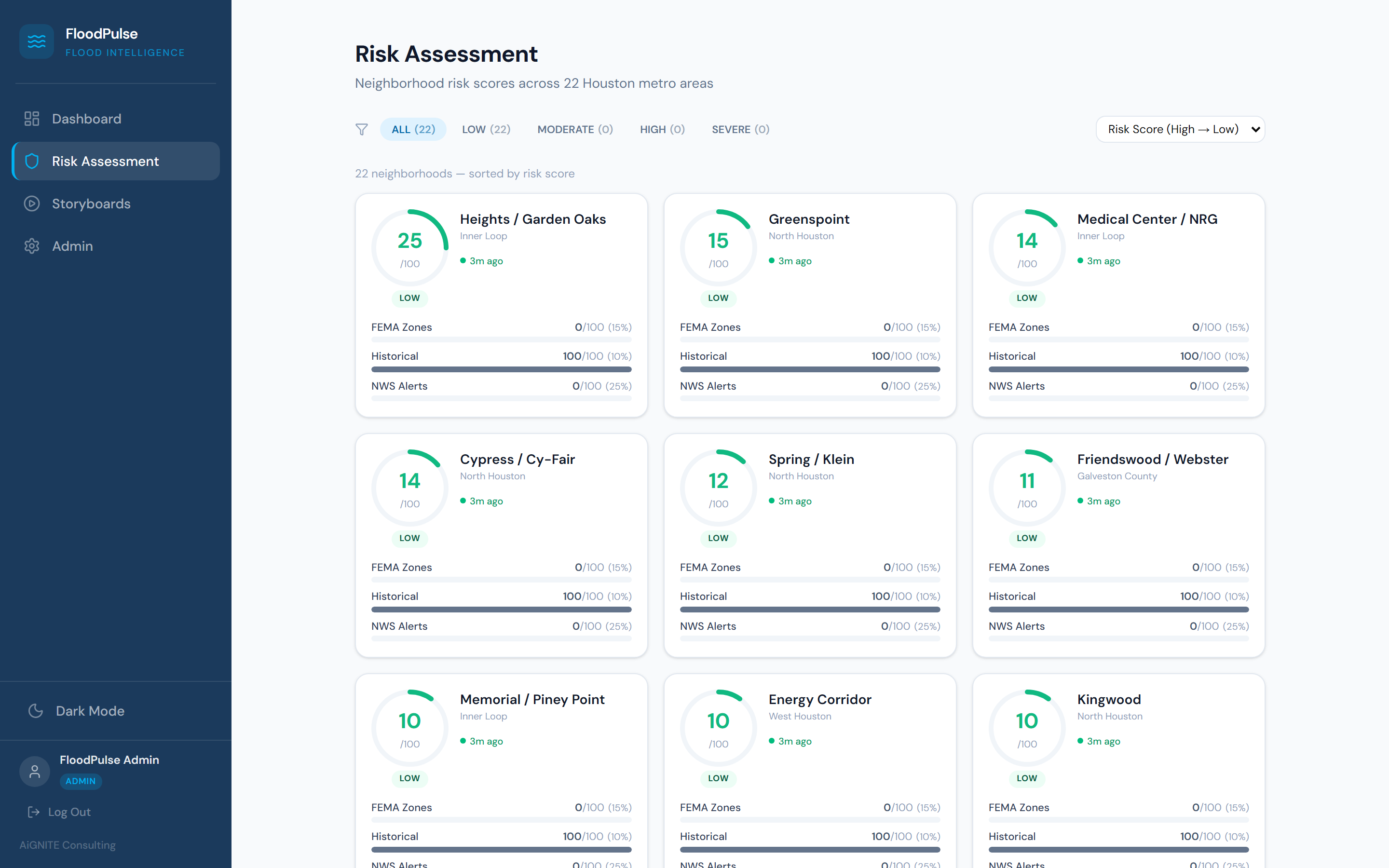
Cited Risk Assessments
5-signal composite risk score (0–100) for every neighborhood: gage levels, NWS alerts, FEMA zone exposure, historical flood frequency, and rainfall anomaly. Claude AI generates cited narrative assessments with specific gage references and NWS bulletin IDs.
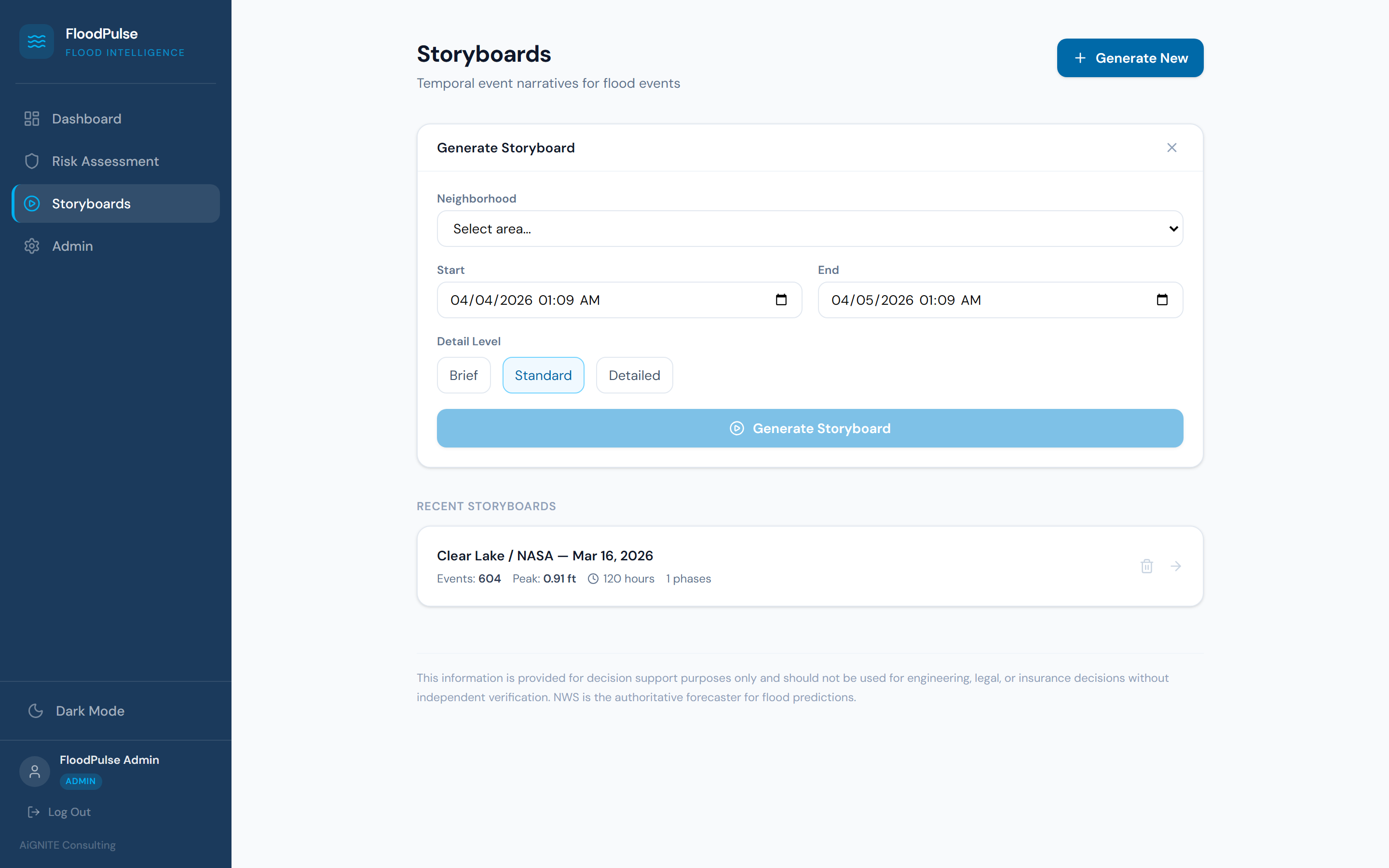
Post-Event Storyboards
The killer feature. After any flood event, FloodPulse generates a 5-phase chronological storyboard: Pre-Event Baseline, Rising Threat, Peak Impact, Recession, and Recovery. Each phase includes timestamped gage readings, NWS alerts, road closures, and AI-cited narrative.
Road Impact Scoring
22 flood-prone road segments across the Houston metro, each linked to upstream gages. Real-time passability scoring based on gage height thresholds. Historical closure frequency and average closure duration for logistics planning.
Natural Language Query
Ask plain English questions: ‘Is Brays Bayou at risk of flooding this week?’ or ‘Show me the last 3 flood events in Meyerland.’ FloodPulse queries its database and returns cited answers with gage data, NWS references, and FEMA zone context.
18-Neighborhood Coverage
Houston metro divided into 4 sub-regions (Northwest, Northeast, Southwest, Southeast) with 18 neighborhoods. Each neighborhood has a dedicated risk profile, assigned gages, FEMA zone breakdown, and historical flood event timeline.
Anomaly Detection
Dual-signal anomaly detection: rate-of-rise anomalies (gage level climbing faster than historical norm) and absolute threshold anomalies (gage exceeding flood stage). Alerts fire before NWS warnings in many cases.
MCP Integration
6 MCP tools for Claude Desktop, Cursor, or any MCP-compatible AI. Query flood risk, pull gage readings, retrieve storyboards, and check road status — all from within your existing AI workflow. Build flood-aware applications without a single API call.
From Raw Gage Data to Cited Intelligence, Automatically
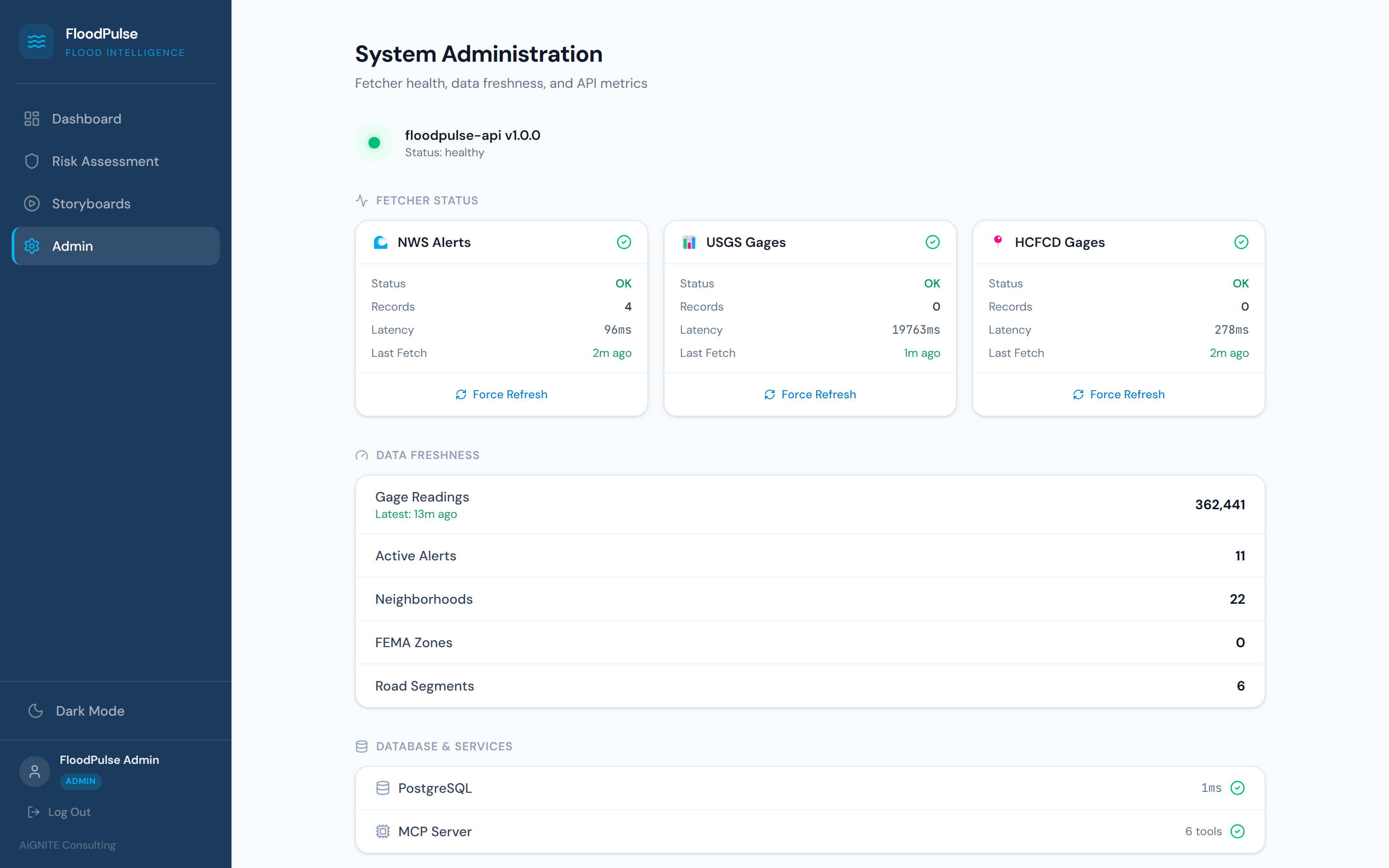
Ingest
HCFCD, NWS, USGS, and FEMA data ingested every 5–15 minutes. Normalized into unified gage, alert, and zone schemas.
Detect
Dual-signal anomaly detection: rate-of-rise and absolute threshold checks across all 63+ gage stations.
Score
5-signal weighted composite risk score (0–100) computed for each of 18 neighborhoods.
Generate
RAG pipeline with Claude AI produces cited risk narratives and post-event storyboards.
Present
Map-first UI with live dashboards, PDF export, email alerts, and MCP server for AI tool integration.
The Platform
Real-Time Flood Map
Neighborhood Risk Assessment
Post-Event Storyboard
Data Pipeline Dashboard
FloodPulse in Your Pocket
The same cited Houston flood intelligence, on your phone. A live watershed map with neighborhood risk scores, active NWS alerts, and a natural-language Ask AI for plain-English answers, each labeled decision support with official NWS and local warnings kept front and center.
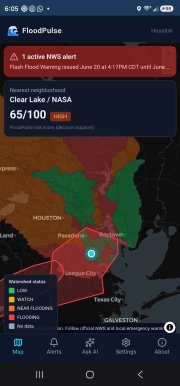
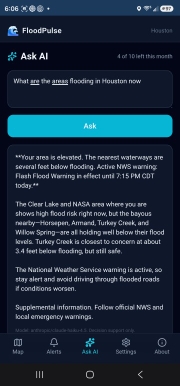
Available at floodpulseai.com. Decision support only, not for life-safety decisions, always follow official NWS and local emergency warnings.
4 Government Data Sources. Zero Proprietary Data.
| Source | Frequency | ||
|---|---|---|---|
| HCFCD Flood Warning | Every 5 min | ||
| NWS API | Every 5 min | ||
| USGS Water Data | Every 15 min | ||
| FEMA NFHL | Quarterly | ||
| Post-MVP | |||
| Houston TranStar | — | ||
| NOAA CDO | — | ||
All data sourced from public U.S. government databases. No commercial data licensing required. Every AI-generated claim includes verifiable citations to source gage readings and NWS bulletins.
Built for Houston's Flood-Exposed Organizations
Emergency Management
Post-event storyboards provide the chronological, cited documentation required for FEMA BRIC grant applications and after-action reports. Real-time gage maps give EOCs situational awareness during active events.
Insurance & Claims
Neighborhood-level flood exposure scoring replaces ZIP-code-level guesswork. Storyboards provide timestamped evidence for claims adjudication. FEMA zone overlays show exact policy-relevant flood designations.
Logistics & Supply Chain
22 flood-prone road segments scored for real-time passability. Historical closure frequency and duration data for route planning. Anomaly alerts give advance warning to reroute before road closures hit.
Real Estate & Development
Site-level flood risk assessments combining FEMA zone data, upstream gage proximity, historical flood frequency, and neighborhood composite scores. Due diligence reports generated on demand.
Interested in FloodPulse?
Contact us to discuss your use case and request a personalized demo.
Contact UsEnterprise-Grade Architecture
┌─────────────────────────────────────────────────────────┐
│                    DATA INGESTION                       │
│  HCFCD (5min) │ NWS API (5min) │ USGS (15min) │ FEMA   │
└──────────────────────┬──────────────────────────────────┘
                       │
              ┌────────▼────────┐
              │  ANOMALY ENGINE │
              │  Rate-of-Rise + │
              │  Threshold      │
              └────────┬────────┘
                       │
         ┌─────────────▼──────────────┐
         │   SCORING & RISK ENGINE    │
         │  5-signal composite (0-100)│
         │  18 neighborhoods × 4 sub  │
         └─────────────┬──────────────┘
                       │
         ┌─────────────▼──────────────┐
         │   RAG + CLAUDE AI ENGINE   │
         │  Cited risk assessments    │
         │  Post-event storyboards    │
         └─────────────┬──────────────┘
                       │
    ┌──────────────────▼──────────────────┐
    │          PRESENTATION LAYER         │
    │  Map UI │ Dashboards │ PDF │ MCP(6) │
└─────────────────────────────────────┘Stop Guessing About Flood Risk
Request a personalized demo with live Houston gage data and neighborhood risk assessments.
FloodPulse provides decision support intelligence only, not for engineering, legal, or insurance decisions without independent verification. Always consult official sources (HCFCD, NWS, FEMA) for life-safety decisions.